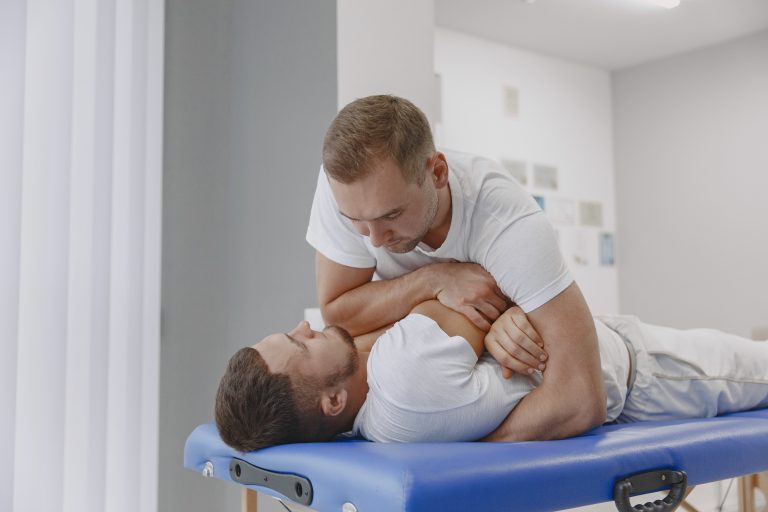

A herniated disc can cause more than back or neck pain. When a disc affects a nearby nerve root, symptoms may extend into an arm or leg and include burning pain, tingling, numbness, or weakness.
For many people, appropriate exercise and physical rehabilitation can be part of conservative treatment.
But there is an important point:
There is no single set of herniated disc exercises that is right for everyone.
The best movements depend on where the affected disc is located, whether a nerve is involved, which movements improve or worsen symptoms, and your overall physical condition.
Below are several exercises commonly considered during rehabilitation, along with guidance on what to avoid and when symptoms require professional evaluation.
What Is a Herniated Disc?
The spine contains discs between the vertebrae that help distribute loads and allow movement.
A herniated disc occurs when material from inside a spinal disc extends through its outer layers.
A herniated disc does not always cause symptoms.
When disc material irritates or compresses a nearby nerve root, however, symptoms can include:
- Lower back or neck pain
- Pain traveling into an arm or leg
- Burning or electric-like pain
- Tingling
- Numbness
- Muscle weakness
A lumbar herniated disc can sometimes cause sciatica, with symptoms extending from the lower back or buttock into the leg.
Learn more about living with a herniated disc.
Can Physical Therapy Help a Herniated Disc?
Physical therapy and exercise may be included in conservative management of a symptomatic herniated disc.
Depending on the individual, rehabilitation may focus on:
- Maintaining or restoring movement
- Improving trunk and hip strength
- Increasing tolerance for everyday activities
- Gradually returning to work or exercise
- Improving movement patterns
- Managing symptoms
- Reducing fear of normal movement
Physical therapy does not simply “push the disc back into place.”
The goal is generally to improve symptoms and function while allowing the individual to progressively return to normal activities.
Can a Herniated Disc Heal Without Surgery?
Many people with disc-related symptoms can be managed without surgery, although the appropriate treatment depends on the individual case.
Conservative care may include combinations of:
- Activity modification
- Exercise and rehabilitation
- Appropriate medication
- Physical therapy
- Other non-surgical treatments
Surgery may become more relevant in certain situations, particularly when significant neurological deficits are present or symptoms remain severe despite appropriate conservative management.
Read our comparison of spinal decompression vs. surgery.
Before Starting Herniated Disc Exercises
An exercise should not be considered appropriate simply because it appears on a list of “best exercises for herniated discs.”
Pay attention to what happens to your symptoms.
An exercise may need to be stopped or modified if it causes:
- Pain to travel farther into an arm or leg
- Increasing numbness
- Increasing tingling
- New or worsening weakness
- Sharp or electric-like pain
- Significant worsening that persists after exercise
Conversely, an exercise that makes symptoms retreat from the leg toward the lower back may sometimes represent a more favorable response.
The overall pattern matters more than simply whether you feel some muscular effort during exercise.
7 Physical Therapy Exercises for a Lumbar Herniated Disc
The following movements may be used in rehabilitation programs for selected patients.
They are not universal prescriptions.
1. Pelvic Tilt
Pelvic tilts provide gentle lumbar movement while engaging the abdominal muscles.
How to Do It
- Lie on your back with your knees bent.
- Keep both feet comfortably on the floor.
- Gently tighten your abdominal muscles.
- Slowly flatten your lower back toward the floor.
- Relax back to a comfortable neutral position.
- Repeat slowly as tolerated.
Avoid aggressively pressing your spine into the floor.
The movement should remain controlled and comfortable.
2. Prone Lying
For some people with lumbar disc-related symptoms, simply lying on the stomach may be a starting position before attempting more active extension movements.
How to Do It
- Lie on your stomach.
- Keep your body relaxed.
- If necessary, use a comfortable position for your head.
- Monitor what happens to your back and leg symptoms.
If this position significantly increases radiating leg pain, it may not be appropriate for you.
3. Prone Press-Up
Extension-based movements are commonly associated with some rehabilitation approaches for lumbar disc symptoms.
However, they are not appropriate for every herniated disc.
How to Do It
- Lie on your stomach.
- Place your hands near your shoulders.
- Slowly raise your upper body using your arms.
- Keep your hips relaxed.
- Move only through a comfortable range.
- Return slowly to the starting position.
What Should You Watch For?
Pay particular attention to your leg symptoms.
If pain moves farther down the leg or numbness and tingling increase, stop.
Do not continue simply because press-ups are commonly recommended online for herniated discs.
4. Bird Dog
Bird dog challenges trunk stability without requiring large spinal movements.
How to Do It
- Begin on your hands and knees.
- Keep your trunk in a comfortable neutral position.
- Slowly extend one leg behind you.
- If tolerated, extend the opposite arm.
- Avoid rotating your torso.
- Return to the starting position.
- Repeat on the opposite side.
Focus on control rather than how high you can lift your arm or leg.
5. Glute Bridge
Glute bridges can help strengthen muscles around the hips and trunk.
How to Do It
- Lie on your back with your knees bent.
- Keep your feet on the floor.
- Gently engage your abdominal and gluteal muscles.
- Raise your hips within a comfortable range.
- Pause briefly.
- Slowly lower yourself.
Stop if the movement substantially increases radiating leg symptoms.
6. Modified Dead Bug
A modified dead bug can be used to develop trunk control.
How to Do It
- Lie on your back with your knees bent.
- Gently engage your abdominal muscles.
- Slowly lift or move one limb while keeping your trunk controlled.
- Return to the starting position.
- Alternate sides.
The exercise can be progressed or simplified depending on your strength and symptoms.
7. Walking
Walking is easy to overlook because it doesn’t look like a traditional physical therapy exercise.
For many people, however, gradually maintaining normal physical activity is an important part of recovery.
Start with a duration that you can tolerate.
Rather than forcing one long walk, shorter periods may initially be easier.
If walking consistently produces worsening radiating pain, numbness, or weakness, discuss your symptoms with a healthcare professional.
What About Knee-to-Chest Stretches?
Knee-to-chest movements are frequently recommended online for lower back pain.
However, they involve lumbar flexion and may not be comfortable for every person with disc-related symptoms.
If bringing your knee toward your chest increases radiating pain, do not force the stretch.
This illustrates why the diagnosis “herniated disc” alone is not enough to prescribe the same exercise routine to everyone.
Are Hamstring Stretches Good for a Herniated Disc?
They can be appropriate for some people, but caution is important.
A sensation interpreted as “tight hamstrings” may sometimes involve neural tension.
Aggressively stretching into:
- Burning
- Tingling
- Numbness
- Electric sensations
- Radiating leg pain
is not the same as performing a normal muscle stretch.
If a hamstring stretch reproduces sciatic symptoms, it should be modified or discontinued.
What Exercises Should You Avoid With a Herniated Disc?
There is no universal list of exercises that every person with a herniated disc must permanently avoid.
Instead, exercise selection should depend on symptoms, technique, load, stage of recovery, and individual response.
Be cautious with movements that:
- Consistently make pain travel farther into the arm or leg
- Increase numbness or tingling
- Produce new weakness
- Require loads you cannot control
- Cause significant symptoms that persist afterward
This approach is more useful than simply labeling bending, lifting, twisting, squats, or abdominal exercises as universally “bad.”
Are Toe Touches Bad for a Herniated Disc?
Not necessarily for every person forever.
However, repeated or loaded spinal flexion may aggravate symptoms in some people with an irritated lumbar disc.
During a symptomatic period, aggressive toe-touch stretching may therefore be poorly tolerated.
Whether flexion should be limited depends on your specific symptoms and stage of recovery.
Are Sit-Ups Bad for a Herniated Disc?
Sit-ups are not automatically forbidden for everyone who has ever had a herniated disc.
However, they may not be the best starting exercise during an acute symptomatic period.
Other trunk exercises can sometimes train strength and control with less spinal movement.
Exercise selection can change as symptoms and capacity improve.
Can You Lift Weights With a Herniated Disc?
A herniated disc diagnosis does not necessarily mean you can never lift weights again.
The important considerations include:
- Current symptoms
- Neurological findings
- Exercise technique
- Load
- Training history
- Recovery stage
Returning to resistance training is often a progression rather than an all-or-nothing decision.
A rehabilitation professional can help determine when and how loading should be increased.
Can Squats Make a Herniated Disc Worse?
Squats are not inherently dangerous for every person with a herniated disc.
However, symptoms may worsen if:
- The load is excessive
- Technique is poorly controlled
- The exercise is introduced too early
- The movement consistently reproduces neurological symptoms
Squats may eventually be part of rehabilitation for some people, while others may initially require different exercises.
Should You Stretch a Herniated Disc?
You cannot literally stretch a disc back into its normal position.
Stretching may address certain mobility limitations or muscle tension, but it should have a clear purpose.
More flexibility is not automatically the goal.
The more important question is:
Does this movement improve your symptoms and function without worsening neurological signs?
What Is Centralization With a Herniated Disc?
Some people with radiating leg pain notice that certain movements cause their symptoms to move out of the lower leg and closer toward the lower back.
This pattern is often described as centralization.
For example, pain that initially reaches the foot may later be felt only in the thigh or buttock.
That can sometimes be a useful clinical sign when determining which movements a patient responds to.
However, this does not necessarily mean the exercise physically pushed disc material back into place.
The symptom response is what matters.
What Is Peripheralization?
The opposite pattern can also occur.
Peripheralization describes symptoms moving farther away from the spine.
For example:
Lower-back pain → buttock → thigh → calf → foot.
If an exercise repeatedly causes pain to spread farther down the leg, particularly with increasing numbness or tingling, that movement may need to be stopped or modified.
Herniated Disc Exercises for Sciatica
A lumbar herniated disc can sometimes irritate a nerve root and produce sciatica.
Exercise selection should therefore consider both back and leg symptoms.
Someone with primarily localized back pain may respond differently from someone experiencing:
- Pain into the foot
- Numbness
- Tingling
- Leg weakness
See our guide to 10 Exercises for Sciatica Pain Relief.
You can also learn more about sciatica treatment.
Herniated Disc Exercises for L4-L5 and L5-S1
People frequently search for exercises specifically for an L4-L5 or L5-S1 herniated disc.
However, the MRI level alone does not determine the ideal exercise.
Two people can have a disc abnormality at the same spinal level and experience very different symptoms.
Exercise selection should consider:
- Location of pain
- Direction of radiating symptoms
- Strength
- Sensation
- Movement response
- Functional limitations
This is more useful than selecting exercises based only on an MRI report.
How Often Should You Exercise With a Herniated Disc?
There is no universal schedule such as “10 repetitions three times per day” that is appropriate for everyone.
Frequency depends on:
- Exercise being performed
- Symptoms
- Stage of recovery
- Individual tolerance
- Rehabilitation goals
This is why I would remove the rigid repetition schedules from the old article.
A physical therapist or other qualified rehabilitation professional can adjust frequency according to response.
How Long Does a Herniated Disc Take to Improve?
Recovery time varies considerably.
Rather than expecting improvement after a specific number of days or sessions, monitor changes such as:
- Less radiating pain
- Pain traveling less far down the leg
- Improved walking tolerance
- Better sitting tolerance
- Improved strength
- Easier daily activities
- Greater ability to exercise
Persistent or worsening neurological symptoms deserve reassessment.
Physical Therapy vs. Spinal Decompression for a Herniated Disc
Physical rehabilitation and non-surgical spinal decompression are different approaches.
Physical therapy generally focuses on improving:
- Movement
- Strength
- Physical capacity
- Function
- Gradual return to activity
Non-surgical spinal decompression uses mechanical traction and may be considered for selected spinal conditions.
Neither treatment should automatically be considered better for every patient.
We explain the differences in Spinal Decompression vs. Physical Therapy.
You can also read about spinal decompression for disc conditions.
Can Exercise Prevent Herniated Disc Surgery?
It is too strong to say that exercise can guarantee someone will avoid surgery.
Many patients with disc-related symptoms are initially managed conservatively, and exercise may be one part of that approach.
But surgery can be appropriate in selected cases.
The decision depends on symptoms, neurological findings, response to conservative care, and other clinical factors.
When Should You Stop Exercising and Seek Medical Care?
Seek evaluation if you develop:
- New or worsening weakness
- Increasing numbness
- Significant difficulty walking
- Persistent or progressively worsening radiating pain
- Symptoms following significant trauma
Seek urgent medical attention if you experience:
- New loss of bowel or bladder control
- Numbness around the groin or saddle area
- Rapidly progressive leg weakness
These symptoms can indicate serious neurological compression and should not be managed simply by trying additional exercises.
Frequently Asked Questions
What is the best exercise for a herniated disc?
There is no single best exercise. The appropriate movement depends on the location of the disc problem, neurological symptoms, and how your symptoms respond to different movements.
Is walking good for a herniated disc?
Walking can be an appropriate activity for many people. Start with a tolerable amount and monitor whether symptoms improve, remain stable, or worsen.
Can exercise make a herniated disc worse?
Certain movements or loads can aggravate symptoms, particularly if they increase radiating pain, numbness, tingling, or weakness.
Are McKenzie press-ups good for a herniated disc?
Extension-based exercises may be useful for selected patients but are not appropriate for every herniated disc. Symptom response should guide whether the movement is continued.
Should I do stretches for a herniated disc every day?
Not necessarily. The appropriate type and frequency of stretching depend on your condition and response.
Can I do planks with a herniated disc?
Some people may eventually tolerate planks well, while others may require modified trunk exercises initially. Exercise selection should match current capacity and symptoms.
Can I go to the gym with a herniated disc?
A disc diagnosis does not automatically require permanent avoidance of the gym. Training may need to be temporarily modified and progressively rebuilt.
Can a herniated disc cause sciatica?
Yes. A lumbar disc herniation can irritate a nerve root and cause pain, tingling, numbness, or weakness extending into the leg.
Do herniated discs always require surgery?
No. Many people are managed initially with non-surgical approaches, although surgery may be appropriate in certain cases.
Herniated Disc Treatment and Rehabilitation in Warren, Michigan
The best physical therapy exercises for a herniated disc are not simply the exercises found on the longest online list.
The most useful program is one that considers your symptoms, neurological findings, movement response, physical capacity, and goals.
Spinal Recovery and Joint Center provides evaluation and conservative treatment options for spinal conditions in Warren, Michigan.
Depending on the condition, treatment may incorporate rehabilitation and other appropriate non-surgical approaches.
Spinal Recovery and Joint Center
2243 East 12 Mile Road
Warren, MI 48092
Phone: (586) 573-8100
Explore our treatment options or request an appointment.