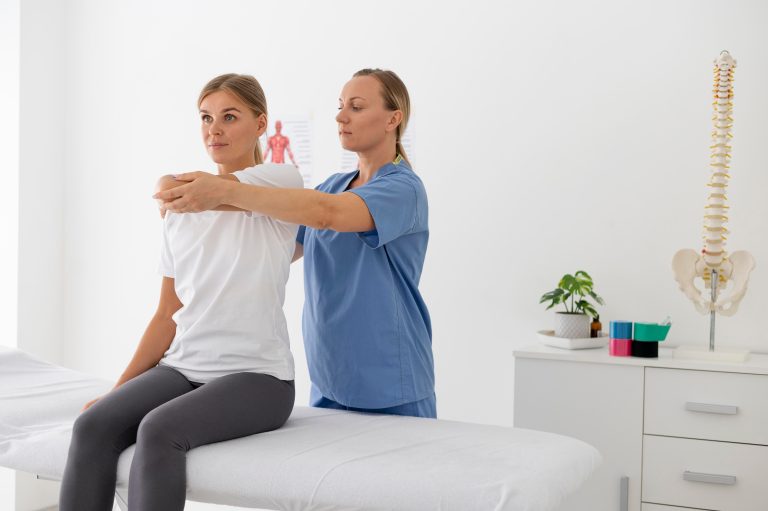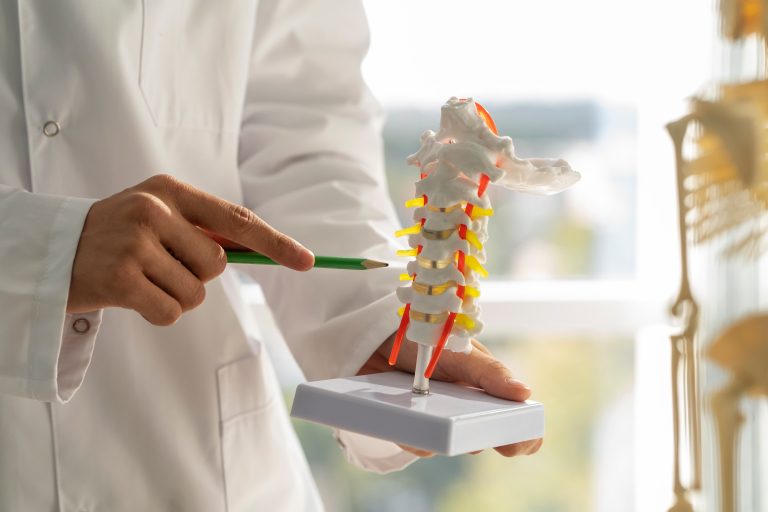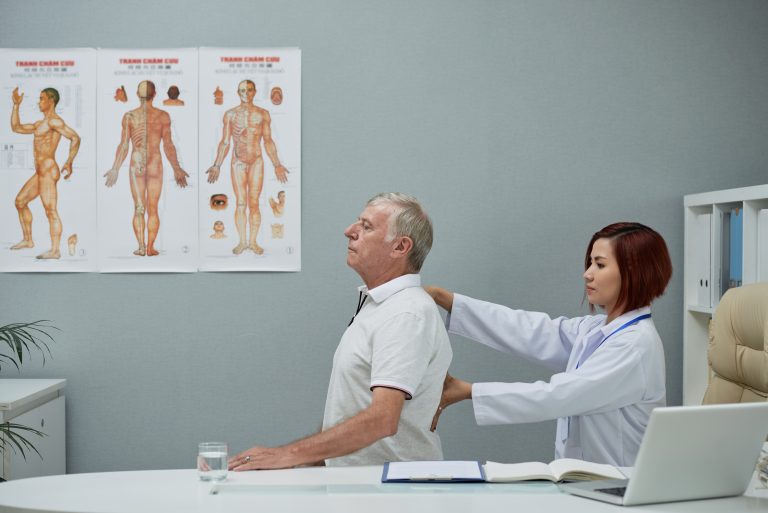

A bulging disc can cause back or neck pain and, when nearby nerves are affected, symptoms such as numbness, tingling, weakness, or pain that travels into an arm or leg.
If conservative treatment is appropriate, one option you may come across is non-surgical spinal decompression therapy.
But does spinal decompression actually help a bulging disc? Can it “fix” the disc? And how many treatments might you need?
The answer depends on your symptoms, the location of the disc problem, whether nerves are involved, and other individual factors.
At Spinal Recovery and Joint Center in Warren, Michigan, non-surgical spinal decompression is one of the treatment options that may be considered for selected patients with disc-related conditions.
What Is a Bulging Disc?
Your spine contains intervertebral discs between the vertebrae. These discs help distribute loads and allow movement between spinal segments.
A bulging disc occurs when part of a disc extends outward beyond its usual boundary.
A bulging disc does not automatically cause pain.
Some disc changes are discovered on imaging in people who have few or no symptoms.
Problems are more likely when the disc or associated changes affect nearby structures, particularly spinal nerve roots.
Symptoms can include:
- Lower back or neck pain
- Pain traveling into an arm or leg
- Tingling
- Numbness
- Muscle weakness
- Reduced tolerance for sitting or standing
- Difficulty performing certain movements or activities
The symptoms depend partly on where the affected disc is located.
Bulging Disc vs. Herniated Disc: What’s the Difference?
These terms are often used interchangeably, but they do not necessarily describe the same disc finding.
A disc bulge generally describes disc tissue extending beyond its usual boundary over a broader portion of the disc.
A herniated disc generally involves a more focal displacement of disc material.
However, the imaging terminology alone does not tell you how severe someone’s symptoms will be.
A relatively small disc abnormality may produce significant nerve symptoms in one person, while another person with more noticeable imaging changes may experience little pain.
That is why treatment decisions should be based on the combination of:
symptoms + examination + function + neurological findings + imaging when appropriate.
What Causes a Bulging Disc?
Disc changes can develop for several reasons.
Potential contributing factors include:
- Age-related disc degeneration
- Repetitive loading
- Heavy lifting
- Repeated bending or twisting
- Previous spinal injury
- Occupational demands
- Individual anatomical and health factors
It is usually too simplistic to blame a bulging disc solely on “bad posture.”
Likewise, having a physically demanding job does not necessarily mean you will develop a symptomatic disc bulge.
What Is Non-Surgical Spinal Decompression?
Non-surgical spinal decompression is a form of mechanical traction.
At Spinal Recovery and Joint Center, treatment is performed using the Triton DTS system.
During treatment, controlled traction is applied to selected regions of the spine according to an individualized treatment plan.
The goal is to modify mechanical loading on spinal structures and potentially reduce symptoms in appropriately selected patients.
Learn more about Non-Surgical Spinal Decompression Therapy.
Does Spinal Decompression Help a Bulging Disc?
It may be considered for some patients with symptomatic disc-related conditions, but it should not be presented as a guaranteed treatment for every bulging disc.
Whether decompression is appropriate depends on factors such as:
- Location of the disc problem
- Symptoms
- Whether a nerve appears to be affected
- Neurological findings
- Severity of functional limitations
- Other spinal conditions
- Overall health
- Previous treatments
Some patients may experience improvement with conservative care, while others may require a different approach.
Can Spinal Decompression Fix a Bulging Disc?
This is an important distinction.
Spinal decompression should not be described as guaranteed to push, suck, or permanently pull a bulging disc back into place.
The primary clinical goal is not necessarily to make an MRI look normal.
Instead, treatment may focus on outcomes such as:
- Reducing symptoms
- Improving movement
- Increasing sitting or walking tolerance
- Reducing radiating symptoms
- Improving daily function
- Helping a patient return to normal activities
A person can sometimes experience meaningful clinical improvement even if structural changes remain visible on imaging.
Does Spinal Decompression Create Negative Pressure in a Disc?
You may see spinal decompression marketed with claims that it creates negative intradiscal pressure that “pulls the disc back into place.”
Mechanical traction can alter forces acting on the spine, but patients should be cautious about interpreting this as proof that a bulging disc will physically retract or heal after treatment.
Clinical outcomes matter more than simplified mechanical explanations.
The important question is:
Are your symptoms and function meaningfully improving?
What Symptoms May Suggest a Bulging Disc Is Affecting a Nerve?
A bulging disc becomes more clinically significant when nerve structures are involved.
Possible symptoms include:
- Shooting pain
- Burning pain
- Tingling
- Numbness
- Pain traveling down a leg
- Pain traveling into an arm
- Muscle weakness
For example, a lumbar disc problem affecting certain nerve roots may contribute to symptoms commonly described as sciatica.
Learn more about Sciatica Treatment and what causes sciatica and how it can be treated.
Spinal Decompression for a Bulging Disc in the Lower Back
Lumbar disc problems can cause symptoms in the lower back and, when nerves are involved, the buttock or leg.
Depending on the affected nerve, symptoms can include:
- Lower back pain
- Leg pain
- Tingling
- Numbness
- Weakness
- Difficulty sitting
- Reduced walking tolerance
Non-surgical spinal decompression may be considered for selected patients after appropriate evaluation.
However, not every case of lower back pain is caused by a bulging disc.
Spinal Decompression for a Bulging Disc in the Neck
Disc problems can also occur in the cervical spine.
When a cervical nerve root is affected, symptoms may extend beyond the neck and include:
- Shoulder pain
- Arm pain
- Tingling
- Numbness
- Weakness
Because neurological symptoms in the arms or hands can have multiple causes, appropriate evaluation is important before beginning treatment.
Is Walking Good for a Bulging Disc?
For many people with back pain, remaining appropriately active may be preferable to prolonged inactivity.
Walking can be a manageable form of activity for some patients.
However, exercise recommendations should depend on:
- Symptoms
- Neurological findings
- Pain response
- Walking tolerance
- Diagnosis
If walking substantially increases radiating pain, numbness, or weakness, the symptoms should be reassessed.
Should You Exercise With a Bulging Disc?
A bulging disc does not automatically mean you should stop exercising.
Appropriate rehabilitation may help improve:
- Strength
- Mobility
- Movement tolerance
- Functional capacity
- Confidence returning to normal activity
But exercise selection matters.
An exercise that helps one person may aggravate another person’s symptoms.
Our guide to Physical Therapy Exercises for Herniated Discs provides additional information about exercise-based rehabilitation for disc conditions.
Spinal Decompression vs. Physical Therapy for a Bulging Disc
These treatments have different goals.
Spinal decompression primarily uses controlled mechanical traction.
Physical therapy generally places greater emphasis on:
- Exercise
- Strength
- Mobility
- Movement
- Functional rehabilitation
One is not automatically better than the other.
Depending on the patient, different treatments may sometimes be incorporated into the same overall care plan.
See our detailed comparison of Spinal Decompression vs. Physical Therapy.
Spinal Decompression vs. Chiropractic Care
Chiropractic care and non-surgical decompression are also different approaches.
Which treatment may be considered depends on the diagnosis, symptoms, neurological findings, health history, and treatment goals.
A bulging disc seen on an MRI does not automatically mean either treatment is necessary.
Spinal Decompression vs. Surgery for a Bulging Disc
A bulging or herniated disc does not automatically mean surgery is necessary.
When there is no urgent neurological problem, conservative treatments may be considered depending on the clinical situation.
However, some patients may require surgical evaluation, particularly when significant neurological deficits are present or symptoms continue to cause major functional limitations despite appropriate conservative care.
Read our guide to Spinal Decompression vs. Surgery for a more detailed comparison.
How Many Spinal Decompression Sessions Are Needed for a Bulging Disc?
There is no universal number.
Claims that every bulging disc requires 15, 20, or 30 treatments oversimplify the decision.
Treatment frequency may depend on:
- Diagnosis
- Severity of symptoms
- Nerve involvement
- Duration of symptoms
- Functional limitations
- Response to treatment
- Overall treatment goals
Most importantly, progress should be reassessed rather than continuing automatically until a predetermined number of sessions has been completed.
We explain this in detail in How Many Spinal Decompression Sessions Do You Really Need?.
How Long Does Spinal Decompression Take to Work for a Bulging Disc?
There is no guaranteed timeline.
Some people may notice changes relatively early, while others may require more time. Some patients may not experience meaningful improvement.
Instead of focusing only on how quickly pain changes, consider functional measures such as:
- Can you sit longer?
- Can you walk farther?
- Is radiating pain decreasing?
- Are you sleeping better?
- Is movement becoming easier?
- Can you perform more normal daily activities?
Read How Long Does Spinal Decompression Take to Work? for a detailed explanation.
How Do You Know if Spinal Decompression Is Working?
Potential signs of meaningful progress may include:
- Lower pain intensity
- Less frequent pain
- Reduced radiating symptoms
- Improved mobility
- Greater sitting tolerance
- Greater walking tolerance
- Improved sleep
- Better ability to work or exercise
- Fewer limitations during everyday activities
Treatment should be reassessed if these measures are not improving.
What if Spinal Decompression Doesn’t Help?
Lack of improvement does not automatically mean you need more decompression sessions.
Instead, it may be appropriate to reconsider:
- Whether the disc is actually causing the symptoms
- Whether nerve involvement has changed
- Whether the diagnosis needs reassessment
- Whether another conservative approach may be more appropriate
- Whether additional evaluation is necessary
The treatment plan should change when the clinical situation changes.
Who May Not Be a Candidate for Spinal Decompression?
Non-surgical spinal decompression is not appropriate for everyone.
Certain medical or spinal conditions may make traction inappropriate or require additional caution.
This is why patients should be evaluated before beginning treatment rather than assuming decompression is safe simply because it is non-surgical.
Your healthcare provider should review relevant medical history, symptoms, and contraindications before recommending treatment.
When Does a Bulging Disc Need Medical Attention?
Seek prompt medical evaluation if symptoms include significant or worsening:
- Muscle weakness
- Numbness
- Difficulty walking
- Neurological changes
Seek urgent medical care for symptoms such as:
- New loss of bowel or bladder control
- Saddle-area numbness
- Rapidly progressive weakness
- Severe neurological symptoms following significant trauma
These symptoms should not be managed simply by scheduling additional decompression treatments.
Frequently Asked Questions
Does spinal decompression work for bulging discs?
It may be considered for selected patients with symptomatic disc-related conditions. Results vary, and it is not appropriate for every bulging disc.
Can spinal decompression fix a bulging disc?
It should not be described as a guaranteed way to permanently push or pull a bulging disc back into place. Treatment is better evaluated according to changes in symptoms and function.
Can a bulging disc heal without surgery?
Many disc problems do not automatically require surgery. Appropriate treatment depends on symptoms, neurological findings, function, and other clinical factors.
How many spinal decompression sessions are needed for a bulging disc?
There is no universal number. The treatment plan should depend on diagnosis, symptoms, response, and measurable progress.
How long does spinal decompression take to work for a bulging disc?
There is no guaranteed timeline. Response varies among patients and should be evaluated according to symptoms and functional improvement.
Is spinal decompression painful?
Patient experiences vary. Treatment generally involves controlled traction, and significant worsening of symptoms should be reported to the treating provider.
Is walking good for a bulging disc?
Walking may be an appropriate activity for many patients, but recommendations should be individualized according to symptoms and functional tolerance.
Can a bulging disc cause sciatica?
Yes. A lumbar disc problem can sometimes irritate or affect a nerve root associated with sciatic symptoms.
Is a bulging disc the same as a herniated disc?
Not exactly. Both describe disc abnormalities, but they refer to different patterns of disc displacement. Symptoms and clinical significance can vary considerably.
Do all bulging discs need treatment?
No. Some disc bulges are found on imaging without causing meaningful symptoms. Treatment should focus on the patient’s clinical condition rather than an imaging finding alone.
Non-Surgical Spinal Decompression for Bulging Discs in Warren, Michigan
A bulging disc does not automatically mean you need surgery – but it also does not mean spinal decompression is automatically the right treatment.
The first step is determining whether the disc finding corresponds with your symptoms and whether conservative treatment is appropriate.
Spinal Recovery and Joint Center provides non-surgical spinal decompression using the Triton DTS system as part of individualized spinal and musculoskeletal care.
Spinal Recovery and Joint Center
2243 East 12 Mile Road
Warren, MI 48092
Phone: (586) 573-8100
Learn more about Spinal Decompression Therapy or request an appointment to discuss your symptoms and available treatment options.