
Так, цей блог варто суттєво розширити. Зараз він дуже короткий для запиту, який уже має 758 impressions і позицію 8.9. Тут особливо важливо прибрати твердження на кшталт “spinal nerves amplify normal sensations” і “chiropractic realigns the spine”, а також чітко розділити fibromyalgia pain і структурні проблеми хребта.
Fibromyalgia and Back Pain: How Does Fibromyalgia Affect the Spine?
Fibromyalgia can cause widespread pain, fatigue, sleep problems, and increased sensitivity to pain. For many people, some of the most noticeable symptoms occur in the lower back, upper back, neck, and shoulders.
This can raise an important question:
Does fibromyalgia actually affect the spine, or is back and neck pain caused by something else?
Fibromyalgia can contribute to significant pain around the spine, but it does not necessarily mean that the spinal discs, vertebrae, or nerves are damaged.
At the same time, having fibromyalgia does not prevent someone from developing a separate spinal condition such as a herniated disc, sciatica, spinal stenosis, or another musculoskeletal problem.
Understanding the difference can be important when deciding how back or neck pain should be evaluated and managed.
What Is Fibromyalgia?
Fibromyalgia is a chronic condition commonly associated with:
- Widespread musculoskeletal pain
- Fatigue
- Sleep disturbances
- Increased sensitivity to pain
- Problems with concentration or memory
- Stiffness
- Headaches in some people
Researchers continue to study exactly why fibromyalgia develops.
Current understanding emphasizes changes in how the nervous system processes pain and sensory information rather than viewing fibromyalgia as damage to one particular muscle, joint, or spinal structure.
This distinction is particularly important when discussing fibromyalgia and spinal pain.
Does Fibromyalgia Affect the Spine?
Fibromyalgia can cause pain that is felt around the spine, including the:
- Lower back
- Mid-back
- Upper back
- Neck
- Shoulders
But experiencing spinal pain does not necessarily mean fibromyalgia is physically damaging the spine.
A person can experience substantial back or neck pain even without a structural abnormality that fully explains the severity of the symptoms.
Conversely, someone with fibromyalgia can also develop an independent spinal condition.
Therefore, new or changing back pain should not automatically be attributed to fibromyalgia.
Why Does Fibromyalgia Cause Back Pain?
Fibromyalgia is associated with altered pain processing and increased pain sensitivity.
As a result, sensations that might be relatively minor for another person may feel more painful or persistent to someone with fibromyalgia.
Back discomfort may also be influenced by factors such as:
- Muscle tension
- Reduced activity during symptom flares
- Sleep problems
- Stress
- Physical overexertion
- Other coexisting musculoskeletal conditions
There usually isn’t one single structure responsible for all fibromyalgia-related back pain.
Fibromyalgia and Lower Back Pain
Lower back pain is a common complaint in the general population, so a person with fibromyalgia can experience low back pain for several possible reasons.
Pain may be related to fibromyalgia itself, but other possibilities include:
- Muscle strain
- Joint-related pain
- Herniated or bulging discs
- Nerve irritation
- Sciatica
- Degenerative spinal changes
- Other medical conditions
The location of pain alone cannot determine its cause.
If lower back symptoms change significantly or are accompanied by neurological symptoms, further evaluation may be appropriate.
Fibromyalgia and Neck Pain
Fibromyalgia may also be associated with pain and tenderness around the:
- Neck
- Upper back
- Shoulders
Some people may experience stiffness or headaches alongside these symptoms.
However, neck pain can also arise from conditions unrelated to fibromyalgia.
For example, symptoms extending into an arm along with numbness, tingling, or weakness may warrant evaluation for possible neurological involvement rather than assuming fibromyalgia is responsible.
Fibromyalgia vs. Herniated Disc: How Can You Tell the Difference?
Fibromyalgia and a herniated disc can both involve pain, but they are fundamentally different conditions.
Fibromyalgia generally involves widespread symptoms and altered pain processing.
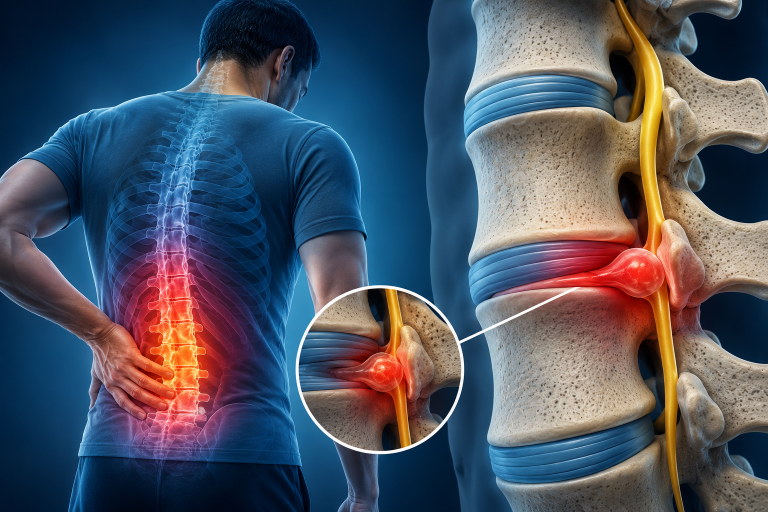
A herniated disc is a structural disc abnormality that may sometimes irritate or compress nearby neurological structures.
A herniated disc affecting a nerve may produce symptoms such as:
- Pain following a particular arm or leg distribution
- Tingling
- Numbness
- Muscle weakness
- Changes in reflexes
Fibromyalgia symptoms tend to be more widespread rather than following one specific nerve root.
However, symptoms can overlap, which is why self-diagnosis can be difficult.
Read more about Living With a Herniated Disc.
Fibromyalgia vs. Sciatica
Sciatica and fibromyalgia are also different.
Sciatica describes symptoms associated with irritation or compression involving nerve roots that contribute to the sciatic nerve.
Symptoms commonly travel from the lower back or buttock into the leg.
They may include:
- Shooting pain
- Burning
- Tingling
- Numbness
- Weakness
Fibromyalgia, by contrast, typically produces more widespread symptoms.
Someone can also have both fibromyalgia and sciatica.
New one-sided pain traveling down a leg should therefore not automatically be assumed to be a fibromyalgia flare.
Learn more about Sciatica Treatment and what causes sciatica.
Can Fibromyalgia Cause Nerve Pain?
People with fibromyalgia sometimes describe their pain using words such as:
- Burning
- Tingling
- Shooting
- Electric
- Pins and needles
But sensations that feel “nerve-like” do not automatically mean a spinal nerve is compressed.
Peripheral neuropathy, radiculopathy, nerve entrapment, and other neurological conditions can produce similar symptoms.
This is another reason persistent or changing neurological symptoms should be evaluated rather than automatically attributed to fibromyalgia.
See How to Relieve Nerve Pain Without Surgery for more information about different causes of nerve-related symptoms.
Can Fibromyalgia Cause a Herniated Disc?
Fibromyalgia itself should not be described as a direct cause of a herniated disc.
A person with fibromyalgia can certainly develop a herniated disc, but these are separate conditions.
Likewise, finding a disc abnormality on imaging does not necessarily mean it explains all of a person’s widespread pain.
A healthcare professional can help determine whether a structural spinal finding corresponds with the symptoms.
Can Fibromyalgia Cause Spinal Stenosis?
Fibromyalgia is not the same as spinal stenosis and should not be presented as a direct cause of it.
Spinal stenosis involves narrowing around neurological structures in the spine.
It can sometimes cause symptoms such as:
- Leg pain
- Numbness
- Tingling
- Weakness
- Difficulty standing or walking for prolonged periods
Someone with fibromyalgia may also have spinal stenosis, particularly because different conditions can coexist.
How Do You Know if Back Pain Is Fibromyalgia or Something Else?
There is no single home test that can reliably make this distinction.
However, certain changes deserve particular attention.
Consider evaluation if you develop:
- New pain that feels substantially different from your usual symptoms
- Pain consistently traveling down one arm or leg
- Persistent numbness
- New muscle weakness
- Significant changes in walking
- Symptoms following an injury
- Progressively worsening neurological symptoms
The fact that someone has fibromyalgia should not prevent investigation of a new medical problem.
Does Fibromyalgia Show Up on an MRI?
Fibromyalgia itself is not diagnosed by finding a characteristic abnormality on a routine spinal MRI.
Imaging may instead be used when a healthcare professional suspects another condition that could explain particular symptoms.
For example, imaging might identify:
- Disc abnormalities
- Spinal stenosis
- Degenerative changes
- Other structural findings
Importantly, an imaging finding should still be interpreted together with symptoms and examination findings.
What Can Help Fibromyalgia-Related Back and Neck Pain?
Management is usually broader than treating one specific spinal structure.
Depending on the individual, care may include:
- Appropriate physical activity
- Exercise
- Sleep management
- Stress-management strategies
- Physical rehabilitation
- Medication when appropriate
- Management of coexisting musculoskeletal conditions
- Education about symptom management
Treatment should be individualized because fibromyalgia symptoms and tolerance for activity vary considerably.
Exercise and Fibromyalgia
Appropriate physical activity can be an important component of fibromyalgia management.
Depending on the individual, activity may include:
- Walking
- Gentle strengthening
- Mobility exercises
- Low-impact aerobic activity
- Aquatic exercise
- Gradual conditioning
The goal is not to push through severe symptoms.
Instead, activity can be gradually adjusted according to tolerance.
Large increases in activity followed by prolonged inactivity may be difficult for some people with fibromyalgia, so sustainable progression can be important.
Physical Therapy for Fibromyalgia and Back Pain
Physical rehabilitation may help address problems such as:
- Reduced strength
- Limited mobility
- Difficulty performing daily activities
- Reduced exercise tolerance
- Coexisting musculoskeletal pain
A program should be adapted to the individual’s symptoms rather than using the same exercise intensity for every patient.
Can Massage Help Fibromyalgia Back Pain?
Some people with fibromyalgia find massage comfortable and helpful for associated muscle tension or relaxation.
However, sensitivity to pressure can vary substantially.
Deep pressure that feels helpful to one patient may be uncomfortable for another.
Massage should therefore be adjusted according to individual tolerance rather than assuming deeper pressure produces better results.
For more information about massage approaches, read Massage Therapy for Back and Neck Pain.
Can Chiropractic Care Help Fibromyalgia?
Chiropractic care should not be presented as a cure for fibromyalgia or as a way to “realign” the spine to correct the condition.
For some patients, conservative musculoskeletal care may be considered for specific coexisting back or neck complaints.
Whether chiropractic treatment is appropriate depends on:
- Symptoms
- Diagnosis
- Medical history
- Examination findings
- Individual tolerance
Treatment should address an identified musculoskeletal problem rather than assuming every symptom is caused by spinal misalignment.
Can Spinal Decompression Treat Fibromyalgia?
Spinal decompression is not a treatment for fibromyalgia itself.
This distinction is important.
Non-surgical spinal decompression may be considered when a patient has a separate spinal or disc-related condition that is appropriate for mechanical traction.
For example, a person with fibromyalgia could also have a symptomatic disc condition.
In that situation, decompression would be considered for the spinal condition, not as a treatment for fibromyalgia.
Learn more about Non-Surgical Spinal Decompression.
How Does Sleep Affect Fibromyalgia Pain?
Sleep disturbances are common among people with fibromyalgia.
Poor sleep and pain can also interact with one another: pain can make sleeping difficult, while inadequate sleep may contribute to greater symptom burden.
Useful sleep strategies may include:
- Maintaining a consistent sleep schedule
- Creating a comfortable sleep environment
- Limiting habits that interfere with sleep
- Discussing persistent sleep problems with a healthcare professional
Improving sleep does not cure fibromyalgia, but sleep is an important part of overall symptom management.
Can Stress Make Fibromyalgia Back Pain Worse?
Stress does not mean that fibromyalgia pain is imaginary or purely psychological.
However, stress can interact with sleep, muscle tension, activity levels, and pain perception.
Some people incorporate:
- Breathing exercises
- Mindfulness
- Relaxation techniques
- Gentle physical activity
- Yoga when appropriate
into their broader symptom-management strategy.
What Should You Avoid During a Fibromyalgia Flare?
There is no universal list of activities that everyone with fibromyalgia needs to avoid.
Instead, it may be useful to avoid extremes.
For example:
- Suddenly increasing exercise intensity
- Repeatedly performing activities that substantially worsen symptoms
- Prolonged inactivity
- Ignoring significant new neurological symptoms
A gradual and individualized approach is generally more useful than assuming complete rest is necessary whenever symptoms increase.
When Back Pain May Not Be From Fibromyalgia
Having fibromyalgia can make it easy to attribute every new symptom to the condition.
But seek medical evaluation for symptoms that are new, substantially different, persistent, or progressive.
Particular attention should be given to:
- New weakness
- Increasing numbness
- Significant balance or walking problems
- Persistent radiating arm or leg pain
- Symptoms after significant trauma
Seek urgent medical care for symptoms such as:
- New loss of bowel or bladder control
- Saddle-area numbness
- Rapidly progressive weakness
These symptoms can indicate neurological problems requiring prompt evaluation.
Frequently Asked Questions
Does fibromyalgia affect your spine?
Fibromyalgia can cause substantial pain around the back and neck, but it does not necessarily mean the spinal structures themselves are damaged.
Can fibromyalgia cause severe back pain?
Yes, people with fibromyalgia can experience significant back pain. However, severe or changing pain should not automatically be attributed to fibromyalgia because another condition may also be present.
Is fibromyalgia a spinal disorder?
Fibromyalgia is not simply a structural disorder of the spine. It is a chronic condition associated with widespread pain and altered pain processing.
Can fibromyalgia cause sciatica?
Fibromyalgia itself is not the same as sciatica. A person can have both conditions, and new pain traveling down a leg may warrant evaluation for a spinal or neurological cause.
Can fibromyalgia cause a herniated disc?
Fibromyalgia should not be described as a direct cause of a herniated disc. They are separate conditions that can coexist.
Can fibromyalgia cause numbness and tingling?
People with fibromyalgia can report these sensations, but persistent numbness or tingling can have other neurological causes and may need evaluation.
Does fibromyalgia show on an MRI?
Routine spinal MRI does not diagnose fibromyalgia. Imaging may instead identify other structural conditions that could be contributing to symptoms.
Is massage good for fibromyalgia?
Some patients find massage helpful for comfort or muscle tension, but pressure should be adjusted because sensitivity varies.
Does spinal decompression help fibromyalgia?
Spinal decompression does not treat fibromyalgia itself. It may be considered only when a separate spinal condition appropriate for decompression is also present.
What type of doctor should I see for fibromyalgia and back pain?
The appropriate clinician depends on the symptoms and diagnosis. Persistent or changing spinal or neurological symptoms may require evaluation to determine whether another musculoskeletal or neurological condition is present alongside fibromyalgia.
Fibromyalgia and Back Pain Treatment in Warren, Michigan
Fibromyalgia can make back and neck pain difficult to understand because widespread pain can overlap with symptoms from separate musculoskeletal or spinal conditions.
The key is not to assume that every symptom comes from fibromyalgia – or that every abnormality seen on spinal imaging explains the pain.
Spinal Recovery and Joint Center provides evaluation and multidisciplinary care for spinal and musculoskeletal conditions in Warren, Michigan.
When someone with fibromyalgia also has a separate back, neck, disc, or nerve-related problem, treatment can be individualized according to that specific condition.
Spinal Recovery and Joint Center
2243 East 12 Mile Road
Warren, MI 48092
Phone: (586) 573-8100
Learn more about our treatment options or request an appointment.